
Wichita County Projected Versus Actual Release
KDOC uses the exact KASPER label “Anticipated release date.” That wording matters. It is an estimate based on the sentence and the credit information then available to the Kansas Department of Corrections. Good time can be earned, withheld, or forfeited. Program credit may also affect eligible sentences. A later court order, another custody hold, or a correction to sentence data can change the estimate before a person leaves a state facility.
An actual release date records what occurred. Even then, it must be read with the disposition. Release from one facility may mean transfer to another jail, commitment to KDOC, or the start of parole or postrelease supervision. It does not always mean return to the community. KASPER may later show parole, conditional release, postrelease, or Current Status “Discharged.” Discharged means the KDOC sentence reached its formal end, which can occur well after prison confinement ended.
A pretrial Wichita County detainee is different. No lawful fixed release date exists before the court and custody conditions produce one. Bond may be posted, the court may modify custody, charges may be resolved, or another hold may block release. The Scott County Jail / Law Enforcement Center is the physical custodian for Wichita County detainees under the county contract, while the criminal case remains a Wichita County court matter.
Find Wichita County Projected Release Dates
First determine whether the person is in a county jail, a KDOC prison, or another system. Wichita County does not operate its own jail. KDOC’s official jail list says it contracts with Scott County. Thus a local custody calculation can require both the physical jail record in Scott City and the sentencing or bond order in the Wichita County case. A state-prison date, by contrast, belongs in KASPER.
- Confirm the jurisdiction as Wichita County, Kansas. Do not substitute City of Wichita or Wichita County, Texas results.
- For a state prisoner, open the KASPER offender search and use a name or KDOC registration number.
- Match the record with the KDOC number, birth date, conviction county, case number, photograph, and physical details.
- Read Current Status and the exact Anticipated release date field. Also review facility movements, supervision location, and any discharged date.
- For a Wichita County jail sentence, call the Scott County physical custodian at 620-872-2133 and review the Wichita County sentencing order. Ask for the release calculation and any holds.
- For a pretrial case, inspect the bond and later court orders. Ask whether the custody exit was community release or transfer rather than expecting a fixed projected date.
- Near the expected date, repeat the check. Afterward, confirm the actual exit and disposition with the responsible agency.
The wider Wichita County released-inmate record process helps when the custody path is not known. It separates the Scott County custody event from the Wichita County court record and any later KDOC commitment.
Note: KASPER updates each working day, so a weekend or same-day custody change may not appear at once.
Wichita County KASPER Release Fields
KASPER covers people sentenced to the Kansas Secretary of Corrections since 1980 who are incarcerated, under post-incarceration supervision, or discharged. It is not a complete criminal-history file, and it excludes offenders sent to Kansas under interstate compact. The conviction county identifies the court case. It does not prove where the person now lives or where release will occur.
| KASPER field | How it helps with release | Reading limit |
|---|---|---|
| Anticipated release date | Shows KDOC’s current sentence-based estimate | Can change with credits, orders, and sentence data |
| Current Status | Distinguishes prison, supervision, and Discharged states | Reflects the latest working-day update |
| Facility movements | Shows custody locations and movement dates | A movement is not always community release |
| Supervision level and office | Can show parole, conditional release, postrelease, or compact supervision | Physical release does not equal sentence discharge |
| Discharged Date | Retrospective evidence that the KDOC sentence reached discharge | May be later than release from prison |
| County and case number | Connects the record to a Wichita County conviction | Does not establish a release destination |
The KDOC locating guidance describes these fields and the release-date caution. The official screen below captures that state explanation.

The state’s own use of “anticipated” signals that readers should return near the date and then look for the later status or actual release record.
Wichita County Release Credit Rules
The familiar Kansas “85 percent” claim is shorthand, not a rule for every person. Under K.S.A. 21-6821, good-time reduction is generally capped at 15 percent of the prison portion for sentencing-guidelines crimes committed on or after July 1, 1993. If all eligible credit is earned and kept, that can yield the rough statement that at least about 85 percent is served. Offense date, severity, statutory category, sentence structure, and forfeitures still control.
The same law allows up to 20 percent good time for listed categories. Those include nondrug severity levels 7 through 10 committed on or after January 1, 2008; drug severity levels 3 through 4 committed from January 1, 2008 through June 30, 2012; and drug severity levels 3 through 5 committed on or after July 1, 2012. Eligible prisoners may also receive up to 120 days of program credit for successful completion of designated education, vocational, substance-use, or other recidivism-reduction programs.
Credits are not automatic promises. They may be withheld, forfeited, or not awarded. Certain sex-related sentences can apply credit to postrelease supervision rather than simply remove the obligation. Consecutive or concurrent sentence structure, jail credit, and special offense rules can further alter the computation. This is why the KASPER date must be treated as a current estimate, not a hand calculation based on sentence length alone.
The official good-time statute is shown in the manifest-matched image below.
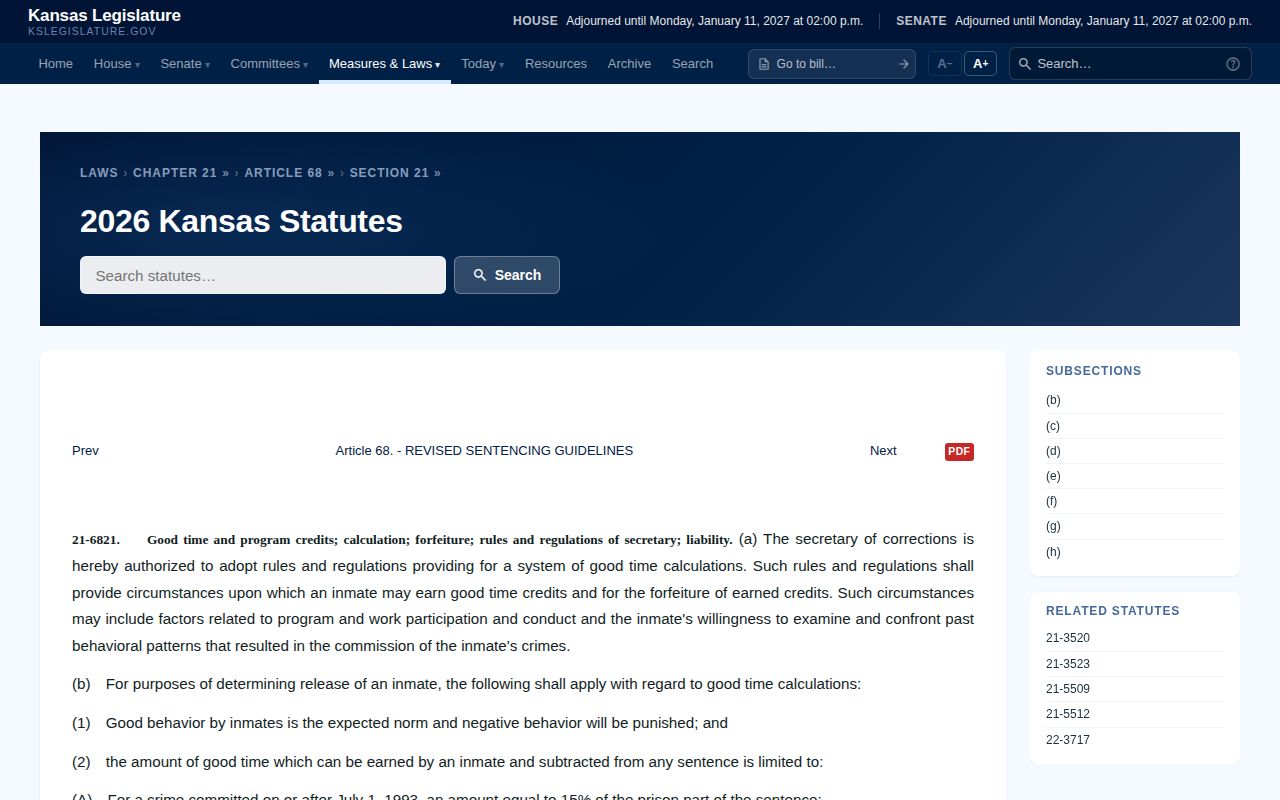
The statutory categories explain why two Kansas sentences of similar length may not produce the same Wichita County projected release date.
Wichita County Sentence Date Differences
Most Kansas guidelines offenses committed on or after July 1, 1993 use a determinate prison portion followed by postrelease supervision. “Determinate” means the prison term is fixed under the sentencing framework. The Prisoner Review Board sets supervision conditions but does not choose whether to move that calculated prison release date forward or backward in the same way it decides parole for an eligible indeterminate case.
Old indeterminate sentences and off-grid sentences follow parole-eligibility and Board processes with many offense-specific exceptions under K.S.A. 22-3717. Eligibility is not a promise of parole. A Board “continue” postpones the decision for more information or deliberation, while a “pass” denies parole for a period. K.S.A. 22-3725 supplies an older good-time framework for qualifying pre-July 1, 1993 sentences.
No official source in the Wichita County research identified a Scott County jail good-time policy, weekend-release rule, or local calculation formula. KDOC prison credits must not be copied onto a county-jail term. The sentencing order, jail-credit calculation, lawful local policy, active holds, and actual custody record control. Ask the Wichita County court and Scott County physical jail for their records rather than estimating from a state-prison statute.
Note: Parole eligibility means the Board may consider release; it does not show that parole was granted or set an actual exit date.
Why Wichita County Release Dates Change
A projected date changes when one of its inputs changes or when another legal authority blocks the expected exit. Some events move the calculation. Others do not alter the sentence date but change where the person goes next. Reading both the date and disposition avoids treating a transfer as community release.
| Factor | Possible effect | Best confirmation |
|---|---|---|
| Good-time earning or withholding | May move the anticipated date within the lawful credit range | KASPER and KDOC sentence computation |
| Disciplinary forfeiture | May delay the estimate by removing earned credit | KDOC record |
| Program credit | May reduce an eligible prison term within statutory limits | KDOC computation under K.S.A. 21-6821 |
| Corrected judgment or court order | Can change sentence length, jail credit, or authority for custody | Wichita County court record and KDOC |
| Detainer or hold | May send the person to another custodian instead of the community | Current facility and receiving agency |
| Parole decision | Controls release timing for eligible indeterminate or off-grid cases | Prisoner Review Board record and later KASPER status |
| Data update or correction | Can revise a public date without a new court event | KASPER correction route or Sentence Computation |
A detainer is a request or authority for another agency to take custody. It can keep someone from walking free even when the first sentence reaches a release point. A transfer record should name the destination or receiving agency. Without that field, a disappearance from a roster answers only that the person is no longer shown there.
Confirm Wichita County Actual Release
Recheck KASPER near the anticipated date because its public data updates each working day. After the expected event, read Current Status, facility movement, supervision level, and any discharged date. Parole, conditional release, or postrelease means the person left prison confinement but remains under supervision. Discharged is the later endpoint of the KDOC sentence.
For county jail, call Scott County as the physical custodian and ask for the actual date, time, release disposition, and receiving agency if transferred. Review the Wichita County case for bond, sentencing, revocation, and later court orders. Kansas VINE may provide a county-jail custody-change alert, but Kansas says it does not cover KDOC prison offenders. A transfer alert is not proof of community release.
When a KDOC computation seems wrong, contact Sentence Computation at 785-296-3317 and identify the official judgment or order supporting the concern. KASPER also provides a public-record correction email, kdoc_pub@ks.gov. For notification about a KDOC prisoner or person supervised by KDOC, use the separate KDOC Victim Services route. The Wichita County VINELink inmate search explains the county-jail notification boundary.
A useful correction request states the person’s KDOC number, the public date at issue, and the exact judgment, journal entry, or credit record believed to conflict with it. Avoid asking an unrelated office to recalculate a sentence. The Wichita County court can supply its own order, Scott County can address the physical jail event, and KDOC Sentence Computation can address a state-prison calculation. Each custodian owns a different part of the record. Keeping those roles separate is especially important here because the filing county and holding county differ. It also creates a clear paper trail if the public KASPER date is later revised.