
Wichita County Inmate Release Meaning
A Wichita County release is the end of one custody event, not always the end of all custody. Wichita County does not operate its own jail. The official Kansas Department of Corrections county-jail list says the county contracts with Scott County. A person arrested in Leoti may therefore have a Wichita County criminal case but a physical booking and custody exit recorded in Scott City. That split controls where proof must come from.
When a person leaves the Scott County facility on bond, by court order, after time served, or at sentence completion, the release may be to the community. Dismissal or acquittal may remove the Wichita County case as a basis for detention, though another hold can still apply. A transfer to KDOC, another county, the U.S. Marshals Service, or immigration authorities ends the local jail stay without releasing the person to the community.
Wichita County Release Types
The release category directs the next search. Court records explain the legal authority, while the physical custody log records the actual exit. A sentence to probation also differs from a prison release to postrelease supervision. These common outcomes should remain separate.
| Release type | What it means | Next source |
|---|---|---|
| Bond or court order | Physical exit may occur if no other hold remains | Scott County custody event and Wichita County case |
| Time served or completion | The local term has ended | Actual exit record, not sentencing arithmetic alone |
| Probation | Community release with court supervision | Wichita County case and named supervising agency |
| KDOC transfer | County-jail custody ends, but incarceration continues | KASPER after state intake |
| Other-agency transfer | Another county, federal, or immigration authority takes custody | Sending record plus receiving system |
| Dismissal or acquittal | That case may no longer support detention | Court disposition plus custody-exit record |
- Time served
- Credit or completion that satisfies the custodial term.
- Parole
- Release from prison under supervision in qualifying cases.
- Probation
- Court-ordered supervision, usually in place of or after a jail term.
- Discharge
- The end of the KDOC sentence and its supervision, not merely departure from prison.
Wichita County Release Record Fields
No single document answers every Wichita County release question. A useful confirmation package joins the physical jail record with the filing-county case. For a state sentence, KASPER adds the custody, supervision, and discharge trail. A narrow request should name the fields needed and should not assume that each agency stores them in the same format.
| Field | What it shows |
|---|---|
| Full name and identifier | Helps distinguish people with similar names |
| Booking number and time | Connects the release to the correct custody event |
| Originating agency | Shows whether Wichita County initiated the matter |
| Charges, case, bond, and holds | Links custody to legal authority and other restraints |
| Actual release date and time | Records when confinement at the facility ended |
| Release disposition | States bond, court order, time served, transfer, or another coded reason |
| Destination or receiving agency | Distinguishes community release from transfer |
| Correction history | Identifies later changes to the agency record |
Does a court order prove the release time? No. The Wichita County case may show bond, dismissal, sentence, or probation, but a second hold can delay the actual exit. Pair the order with Scott County’s custody event.
Why Wichita Releases Need Two Custodians
The contracted-jail arrangement is the defining Wichita County fact. Scott County is likely to have created the physical booking, confinement, and custody-exit record. Wichita County remains the arresting or originating agency and the filing county for a local criminal case. The Wichita County District Court holds the orders that explain bond, dismissal, sentence, probation, revocation, or discharge.
The official KDOC county-jail list identifies the Scott County contract. That means the absence of a Wichita County jail page is not a missing link. It reflects how custody is arranged. A request for actual release time belongs first with Scott County, while a request for Wichita County arrest or transfer records belongs with the originating office.
The Wichita County Sheriff directory shows the local agency contact used to trace the originating matter.
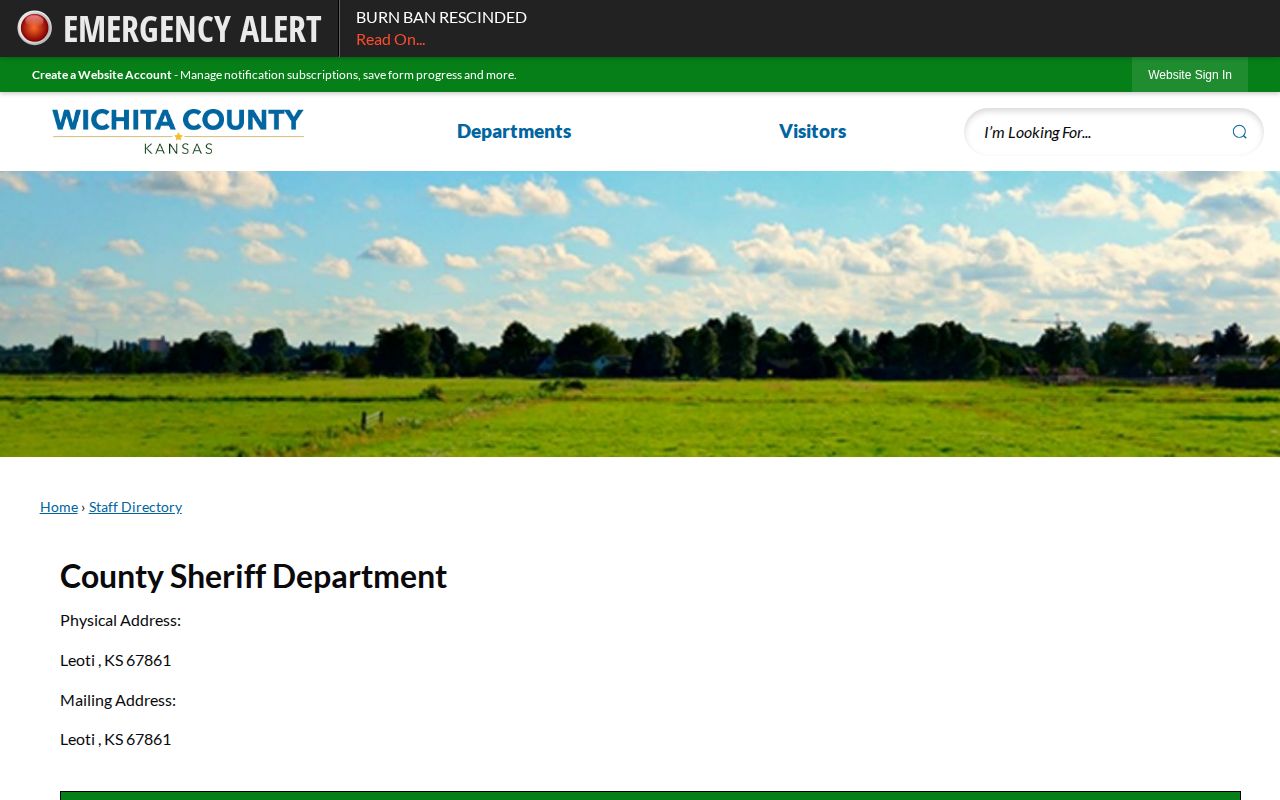
This directory supports the local side of the two-custodian workflow, but it is not a live roster or proof of community release.
Note: Search results for Wichita Falls, Texas, or Wichita in Sedgwick County do not concern Wichita County, Kansas.
Request Wichita County Release Records
Start with the agency that created the desired part of the trail. Scott County should receive a request for the custody-event log, actual exit, disposition, receiving agency, and booking image. Wichita County should receive a request for the originating arrest, transfer, and locally retained records. The court clerk handles case documents. KDOC handles state-sentence and prison records.
- Identify the person, date range, Wichita County matter, and physical holding facility as precisely as possible.
- Ask Scott County for the booking and release record, actual date and time, disposition, destination, holds, case number, and code definitions.
- Use the official Wichita County open-records form for records created or kept by Wichita County.
- Ask for all reasonably segregable public material and a specific legal basis for any withheld part.
- Keep the response with the court disposition and any KASPER result so each record’s role remains clear.
206 S 4th Street
Leoti, KS 67861
Fax: 620-375-4350
Wichita County says requests may be sent by mail, email, or fax and requires its official form. Most records are described as produced within three business days, but Kansas law sets a response or action deadline rather than a guarantee that all records will be produced by then. Fees may be collected in advance for staff time and reproduction. No fixed local jail-release-record price is published.
The Wichita County open-records instructions show the form-based request route.
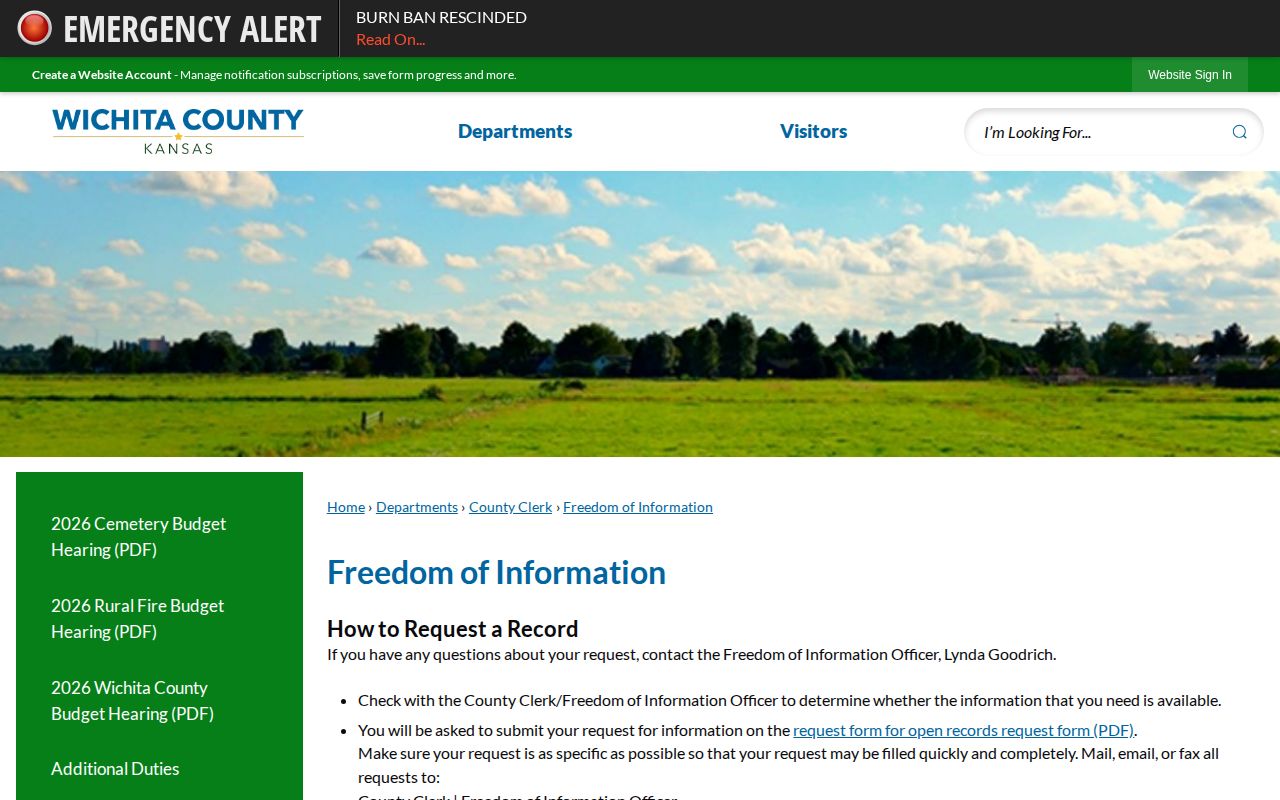
The captured county page confirms the local request channel and fee approach, while Scott County remains the first custodian for the physical jail exit.
Wichita County Release Record Law
K.S.A. 45-218 provides access to Kansas public records unless an exemption applies. An agency must act as soon as possible and no later than the end of the third business day. If production is delayed, the response must explain why and give the earliest availability date. A requested written denial must cite the governing law.
K.S.A. 45-219 permits reasonable actual furnishing costs and prepayment. A requester may ask for itemized employee rates and charges. If estimated work passes five staff hours or $200 in staff cost, the agency must make a reasonable effort to discuss ways to reduce cost. That discussion does not force the requester to narrow.
Release files can still contain exempt or redactable material. Juvenile, medical, victim, investigative, security, sealed, and expunged information may be treated differently. No verified local retention term was found for Scott County booking sheets, custody logs, release records, or photos. Ask which Kansas retention schedule applies and whether an older record was archived or destroyed under that schedule.
When Wichita Release Records Are Expunged
Expungement is a court process that limits public access to an eligible record. Under K.S.A. 21-6614, the waiting period generally runs from satisfying the sentence or discharge from probation, community corrections, parole, postrelease, conditional release, or a suspended sentence. It does not run solely from the day a person walked out of the Scott County facility.
Many eligible misdemeanors and listed lower felonies generally use a three-year period. Listed more serious categories generally use five years, while the statute applies other periods and exclusions to particular offenses. Eligibility should be read from the current statute and case record. After an order, the clerk sends certified notice through KBI to other justice record holders. Official court guidance states that expunged criminal records are not public.
Sealing and expungement can explain why an older court result or document is absent. They should not be confused with a routine roster removal after a custody exit. An absence can also reflect a transfer, spelling difference, data delay, system scope, or the fact that the person was never entered in that system.
Find Wichita County Released Inmates
A released Wichita County inmate normally falls off any current-custody view. No official Wichita County or Scott County online roster, booking search, 24-hour list, 72-hour list, or photo gallery was verified. The search must follow the custody type and join official sources. It should also confirm Kansas, Leoti, or Scott City to avoid geographically wrong results.
- Confirm the identity, date range, and Wichita County, Kansas jurisdiction.
- Call Scott County at 620-872-2133 and ask whether the exit was community release or transfer.
- Call Wichita County Sheriff at 620-375-2723 to identify the holding site and local record custodian.
- Search the Wichita County criminal case for bond, disposition, sentence, probation, revocation, and later discharge entries.
- Use Kansas VINE for a specific county-jail custody event, not as a permanent release archive.
- Search KASPER when transfer to or release from KDOC is possible.
- Submit targeted requests when no online source supplies actual date, disposition, and destination.
For same-day public-feed expectations, the Jail Releases: 24 Hours page explains the local records-first fallback. A specific-person search should still use the full chain above.
Search Wichita Release Court Records
Filing county and holding county diverge here. Search the Wichita County case even though Scott County housed the person. The statewide district court portal may show the case number, parties, judge, hearing dates, and eligible documents. Useful criminal records include the bond order, charge disposition, journal entry of judgment, sentence, probation or revocation entry, and later termination or satisfaction order.
A Wichita County bond or dismissal order explains why that case stopped supporting detention. It does not rule out another case or hold. A sentence states what the court imposed, but it may not prove the exact exit day. A later probation termination or discharge entry gives stronger completion evidence. Scott County’s custody event supplies the physical exit, so both sources are needed.
If a document is missing online, every Kansas district courthouse has a public search terminal. A written clerk request is another channel. Online access depends on the court’s eCourt start date and access rules, while sealed and expunged records are not available to the public.
Note: Search Scott County court records only when a separate Scott County case exists or a record points there.
KASPER Wichita Released Inmate Search
KASPER, the Kansas Adult Supervised Population Electronic Repository, is the released-first source for Kansas state sentences. It covers people sentenced to the Secretary of Corrections since 1980 who are incarcerated, under post-incarceration supervision, or discharged, subject to stated exclusions. It is not an archive of everyone booked in a county jail.
- Open the KASPER search disclaimer and note the working-day update cycle.
- Search by name or KDOC registration number.
- Compare the KDOC number, birth date, description, photograph, conviction county, case, and offense.
- Read Current Status, movement information, supervision location, Anticipated release date, and any Discharged Date.
- Interpret status with the date. An anticipated date does not prove that release occurred.
| KASPER field | How to use it |
|---|---|
| Name and KDOC number | Match the correct state record |
| Photo and physical details | Resolve same-name results |
| County, case, conviction | Connect the state sentence to Wichita County |
| Anticipated release date | Read as a forecast, not an actual exit |
| Current Status | Distinguish prison, supervision, and discharge |
| Discharged Date | Shows when the KDOC sentence reached discharge when displayed |
The official KASPER entry screen shows where a Wichita County state-sentence search begins.
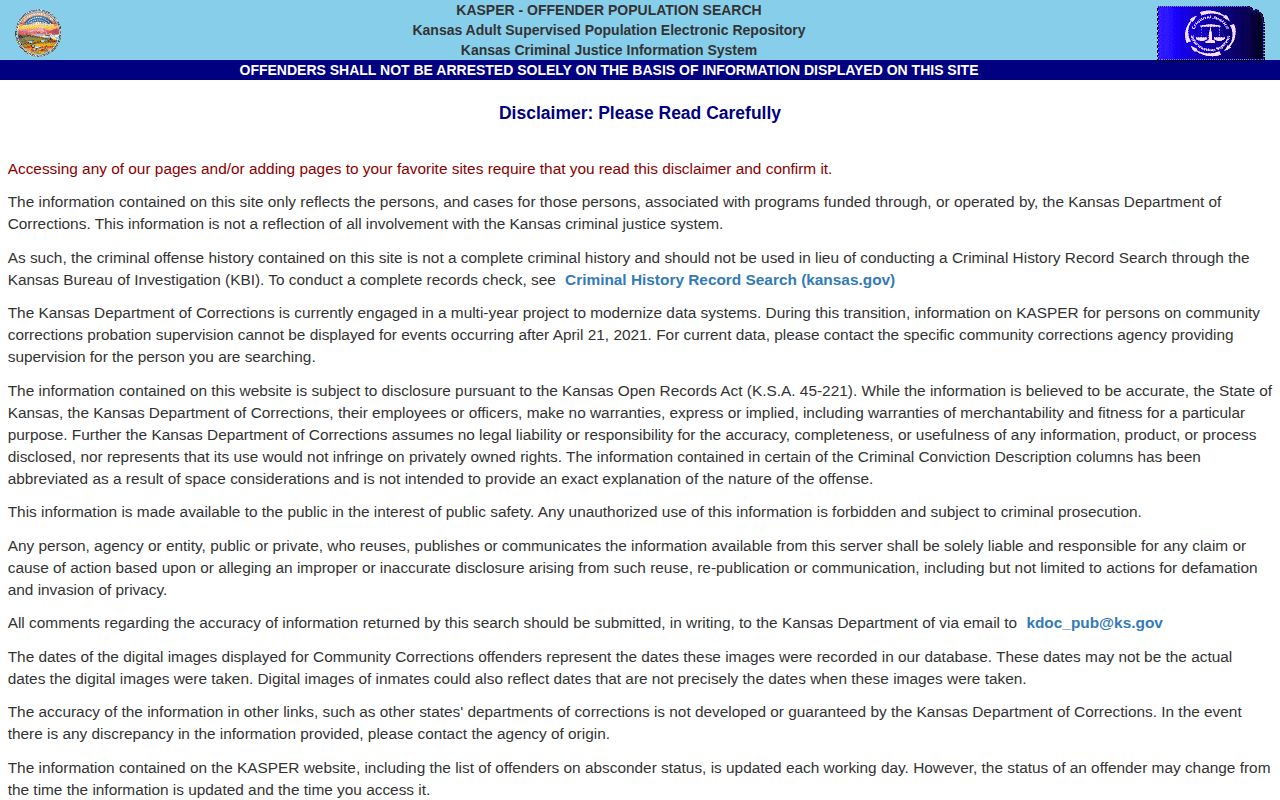
The result must be read by status. Parole, conditional release, or postrelease supervision means the person left prison but remains supervised. “Discharged” is the stronger sign that KDOC supervision ended.
Verify Wichita Post-Release Supervision
KASPER can show parole, conditional release, postrelease supervision, compact supervision, and the office that maintains supervision. Do not assume an office in the City of Wichita serves Wichita County. The city is in Sedgwick County, and the shared name creates a common search error. Use the office shown in the actual record.
Probation is ordered by the Wichita County court and is not parole. Search the case for probation, modification, revocation, and discharge or termination, then contact the named agency. KASPER warns that community-corrections probation events after April 21, 2021 cannot be displayed during data modernization. An absent event does not prove discharge.
A compact case may create another gap because KASPER excludes offenders sent into Kansas under interstate compact. Probation and parole verification must also avoid treating an absconder lead as proof of custody.
Wichita Release Alerts and Transfers
Kansas VINE covers adults housed in county jails and may provide release, transfer, and escape alerts by phone, text, email, or TTY. For a Wichita County detainee housed in Scott County, the relevant county-jail event follows the physical jail’s participating data. A transfer alert proves a custody change, not release to the community.
VINE does not include KDOC prisoners. KASPER and KDOC Victim Services are the proper state-prison routes. The Kansas VINE materials do not promise that an already released person remains visible for a fixed time, so VINE should not be treated as a recent-release archive. Wichita County’s Text My Gov service is also not an inmate or release alert system.
Federal custody requires a different source. The BOP Inmate Locator generally covers federal inmates from 1982 to the present and can show a release date or “Not in BOP Custody.” That status does not establish release from Scott County or completion of federal supervision. ICE’s current detainee locator is used when an immigration transfer is possible, but it is not a permanent criminal-release archive. USMS pretrial movements may require the federal court docket and the responsible district contact.
Match Wichita Release Search Systems
The best source changes with the custody event. A current locator answers where someone is held now. A release record answers how and when one facility’s custody ended. A court order explains legal authority. The comparison below keeps those questions distinct.
| Situation | Primary source | Best confirmation |
|---|---|---|
| Wichita County jail stay | Scott County and VINE while held | Scott County release record plus Wichita County case |
| Transfer to Kansas prison | KASPER | Status, movements, and KDOC records |
| Out of prison under supervision | KASPER | Status and listed supervision office |
| Fully discharged from KDOC | KASPER Discharged status | Discharged Date or targeted KDOC request |
| Probation | Wichita County court | Supervising agency and termination entry |
| Federal sentence | BOP locator | BOP result and federal case when needed |
| Immigration detention | ICE locator | ICE or field-office confirmation |
Why is a released person gone from a current list? A custody roster, where one exists, is designed for people currently held. Once the stay ends, use the agency’s release record, court disposition, or the appropriate state or federal system.
Wichita County Release Facility
Only one facility belongs in the Wichita County facility map. Scott County Jail / Scott County Law Enforcement Center is the contracted physical custody location. Its official address is 602 West 5th Street, Scott City, KS 67871, and its phone is 620-872-2133. No KDOC prison, federal detention center, or ICE facility was verified within Wichita County.
A community exit from Scott County should appear in its custody-event or release record. A transfer to KDOC moves the public search to KASPER. Another county, federal, or immigration transfer moves confirmation to the receiving custodian. Wichita County Sheriff remains relevant for the arrest and local transfer trail, and the Wichita County case remains the correct court record when that county filed the matter.
No official source publishes local release hours, exit-door directions, property-return rules, family waiting instructions, weekend procedures, transport, gate money, or a local bond schedule. Call the facility about the specific release. Do not infer these details from another Kansas jail.
Public Record Search
Sponsored Results