
Wichita County Parole Versus Probation
“Released” does not always mean free from state control. Kansas parole applies mainly to qualifying indeterminate or off-grid prison sentences. The Kansas Prisoner Review Board decides whether a person in those sentence classes is suitable for parole and sets conditions. Most Kansas sentencing-guidelines crimes committed on or after July 1, 1993 instead use a determinate prison term. Release from that prison portion is calculated, then mandatory postrelease supervision begins. Conditional release is another prison-based status. Each can place a person outside prison while the Kansas Department of Corrections, or KDOC, still maintains supervision.
Probation starts with a court order. It may let a defendant remain in the community subject to terms set by the sentencing court. Community corrections can provide the local supervision. The Wichita County criminal case is therefore central when probation is at issue. KASPER, the Kansas Adult Supervised Population Electronic Repository, is stronger for parole, conditional release, postrelease supervision, and compact supervision tied to KDOC.
| Feature | Parole or postrelease | Probation |
|---|---|---|
| Legal source | State prison sentence and Kansas release law | Wichita County court order |
| Public starting point | KASPER current status and supervision office | Wichita County case in the Kansas court portal |
| Decision authority | Kansas Prisoner Review Board for qualifying parole cases; sentence law for determinate postrelease | Sentencing court, with the named supervising agency |
| End record | KASPER discharged status or a KDOC record | Court discharge or termination entry |
- Parole
- Conditional community release granted under the parole system before an eligible sentence reaches its maximum end.
- Postrelease supervision
- A required supervision term that follows the prison portion of many determinate Kansas sentences.
- Probation
- A court-ordered community sentence with conditions, distinct from parole.
- Discharge
- The formal end of the sentence or supervision obligation, not merely the day physical custody ended.
Check Wichita County Supervision Records
Start with identity. Wichita County, Kansas is not the City of Wichita in Sedgwick County and is not Wichita County, Texas. A Wichita parole office should never be assumed to serve this county just because its name matches. Use the conviction county, case number, KDOC number, birth date, and office shown in an official record. For a person who was only in county jail, parole may not apply at all. The Wichita County case can instead show bond, probation, a revocation, or termination.
- Open the KASPER search disclaimer, accept its terms, and search by name or KDOC registration number.
- Compare the KDOC number, date of birth, photograph, conviction county, case number, and physical details. A matching name alone is not enough.
- Read Current Status and the supervision level. Look for parole, conditional release, postrelease supervision, compact supervision, or Discharged.
- Use the parole office or supervision location displayed in KASPER. Confirm the result with that office when the status is current or unclear.
- For probation, search the Wichita County criminal case through the Kansas District Court Public Access Portal. Review probation, modification, revocation, and discharge or termination entries.
- Contact the supervising agency named in the court file. KASPER does not reliably replace the court and agency record for recent community-corrections probation events.
The Wichita County released-inmate search paths provide the broader custody and court sequence when it is not yet clear whether the person left county jail, entered KDOC custody, or began supervision. That distinction prevents a jail release from being misread as a prison discharge.
Wichita County Supervision Office Details
No research source identified one fixed local office that supervises every Wichita County probation or parole case. The correct contact is the office listed in KASPER for KDOC supervision or the agency named in the Wichita County court record for probation. An interstate transfer can place supervision elsewhere. KASPER also excludes offenders sent into Kansas under the Interstate Compact for Adult Offender Supervision, so an absent record may require direct agency confirmation.
KDOC Central Office
714 SW Jackson, Suite 300
Topeka, KS 66603
Phone: 785-296-3317
Use KASPER first, then contact the supervision office shown in the individual record.
The Kansas Prisoner Review Board shares the same Topeka street address and lists a direct line of 785-746-7516. Its role concerns parole decisions and conditions for eligible cases. It is not the routine source for a Wichita County probation order. The clerk’s case record and named community-corrections agency remain the sound route for probation.
For a county-jail event, Kansas VINE has a different role. VINE covers adults housed in participating county jails, not people in KDOC prisons. Wichita County contracts jail custody to Scott County, so a county-jail notification follows the physical jail’s data. Once a person transfers to state prison, KASPER and the separate KDOC Victim Services notification route become relevant. None of these notification services replaces a supervision discharge record.
Note: The office shown in an individual record controls; county-name similarity is not proof that a Sedgwick County office serves Wichita County.
Wichita County Parole Absconder Checks
An absconder is a person whom a supervising agency reports as having stopped complying with required contact or location rules. Kansas maintains separate public search channels for parole absconders and community-corrections absconders. The distinction matters. A parole result relates to KDOC supervision, while a community-corrections result concerns a separate supervision track. The KASPER parole absconder search can filter the last supervision location to Wichita County and may display a photograph.
The official parole-absconder screen makes this unusual local check visible. It is a lead, not final proof of present custody or final case status.
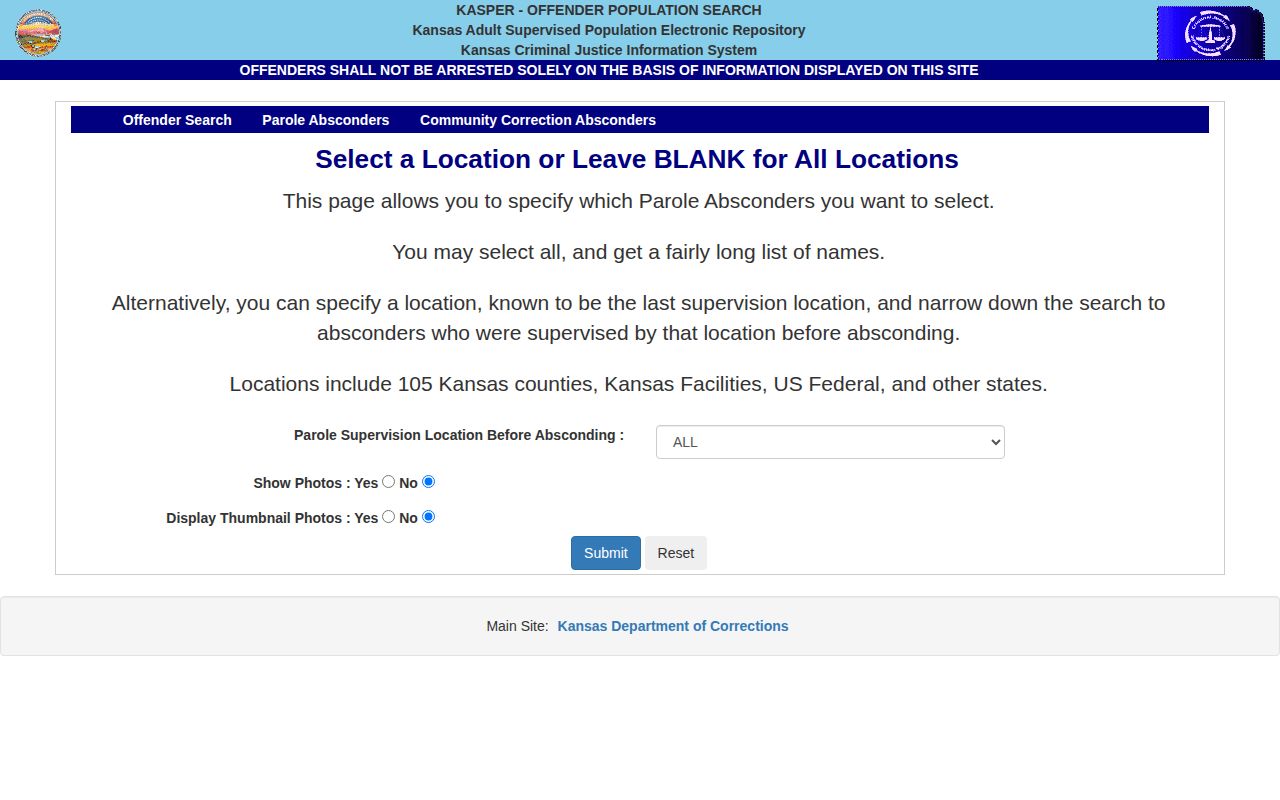
A Wichita County filter narrows the published last supervision location. It does not show that the person is now in Wichita County, nor does it establish a new conviction or full discharge.
Do not attempt an arrest. The official page warns against acting solely on displayed information. Tips may be directed to local law enforcement or KDOC Enforcement, Apprehensions and Investigations at 785-414-7755. A current jail lookup is still required to know whether an absconder was later taken into custody. Court and KDOC records must resolve any later warrant, revocation, or discharge.
Wichita County Release Conditions
Conditions are enforceable rules attached to supervision. They vary by sentence and order. Common areas can include reporting, travel approval, residence, treatment, fees, and compliance with the law, but the individual order controls. A public summary should not be treated as the complete set of terms. For parole and postrelease, the Prisoner Review Board establishes conditions. For probation, consult the sentencing and later modification orders in the Wichita County case.
A claimed violation can lead to investigation, a warrant, a court hearing, revocation, or another response allowed by law. Yet a violation report alone does not prove that revocation occurred. Read the later order or KDOC status. Likewise, “pass” in Kansas parole practice means parole was denied for a stated period. “Continue” means the Board postponed a decision for more deliberation, information, votes, or evaluation. Neither word is an actual release date.
The Prisoner Review Board public-comment calendar and its prospective offender list help identify upcoming parole activity. A Wichita County entry there reflects the county of conviction, not a promise that the person will return to Leoti. The monthly list is not an individual decisions database. After a hearing, KASPER status and the official record are the better sources for the outcome.
The Board’s public process is illustrated in the official calendar screen below.

The calendar gives timing and participation information, while the person-specific supervision record still determines whether release or parole occurred.
Confirm Wichita County Supervision Discharge
Physical release and supervision discharge are separate events. Someone may leave prison on parole, conditional release, or postrelease supervision and remain under KDOC authority. KASPER can show the current level, the office maintaining supervision, and eventually Current Status “Discharged” with a discharged date. That later status is stronger proof that the KDOC sentence reached its end than an earlier prison release date.
For probation, look for a Wichita County court entry that terminates or discharges the probation. A sentencing order only shows what was first imposed. Later orders can modify terms, revoke probation, extend a term, or close supervision. If the public portal does not show the needed document, use the district-court records access route or ask the named supervising agency. Sealed or expunged material may not be publicly available.
Final confirmation should match the system to the legal status: KASPER and KDOC for parole or postrelease, the Wichita County case and local supervising agency for probation, and the responsible office for interstate compact supervision. This sequence also guards against treating absence from one database as proof of discharge.
A records request should be narrow when the public entry does not settle the question. Identify the person, case or KDOC number, and a useful date range. Ask for the order or record that states the supervision type, supervising office, effective date, and termination or discharge. Kansas public-record law allows an agency to redact protected material, so a response may omit private details while still confirming the key status. If one source conflicts with another, give the office the court order or other official document that supports the correction. A current agency record carries more weight than an old search result saved before the latest update.
Note: “Discharged” marks the end of the KDOC sentence; release from confinement may have occurred earlier under active supervision.